Semiconductor stocks have rarely looked this cheap on paper. The S&P 500 Semiconductors index trades at a forward P/E of 13.1x, versus 18.7x for the S&P 500 as a whole. That is the sector’s lowest level since March 2020, although after the financial crisis it mostly traded around 13–17x. Prices have fallen fast: according to Bank of America, the Philadelphia Semiconductor Index is down 38% from its June peak in just 136 days.
So, is this a bargain or a warning? Below we look at what the numbers say, where the traps are, and how to think about semiconductor stocks without guessing where prices go next.
Key takeaways
- The semiconductor sector trades at 13.1x forward earnings, below the S&P 500 at 18.7x.
- A low P/E in a cyclical sector can mean peak earnings, not a cheap price.
- Memory chip stocks behave like commodities; logic and foundry companies have longer visibility.
- The key risk is AI and cloud capex: BofA’s stress test shows a 20% capex cut could put EPS estimates at risk of 35–40% cuts.
- Mid-cycle earnings and company-level valuation matter more than the sector headline.
Table of Contents
Where semiconductor stocks valuation stands now
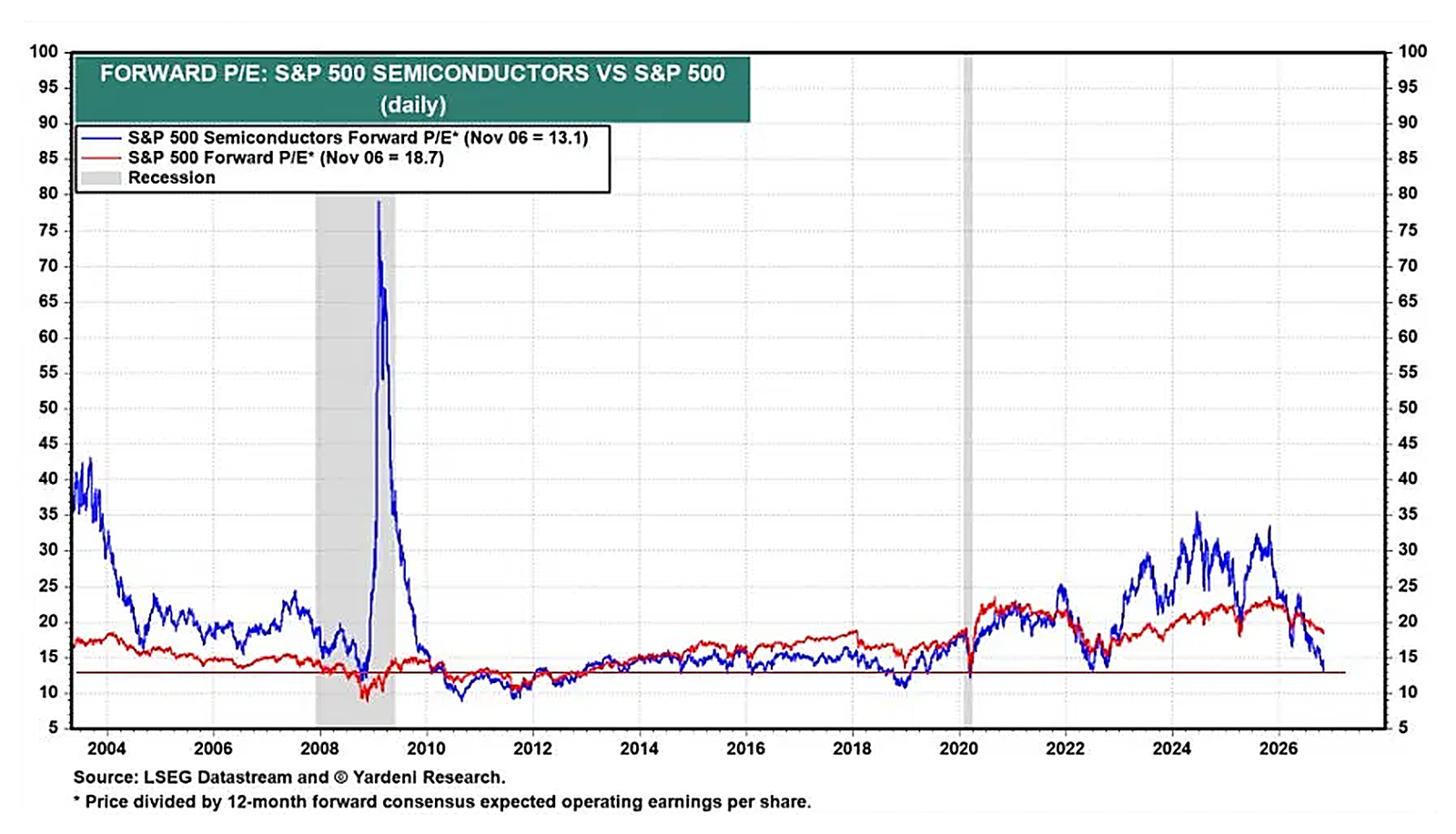
In the chart: the blue line is the forward P/E of the S&P 500 Semiconductors sector (share price divided by expected earnings over the next 12 months); the red line is the S&P 500 as a whole. The horizontal red line marks the sector’s current level, and grey bands mark recessions. The 2009 spike came from collapsing earnings, not expensive stocks. Source: LSEG Datastream and © Yardeni Research, data as of November 6, 2026.
A forward P/E compares today’s share price with the profit analysts expect over the next 12 months. At 13.1x, investors are paying about 13 dollars for every dollar of expected semiconductor earnings, compared with almost 19 dollars for the average S&P 500 company. On the surface, that discount looks attractive.
Why a low P/E can be a trap for semiconductor stocks
In most sectors, a low P/E points to a low price. In cyclical sectors it often points to something else: earnings that are temporarily high. When a cycle peaks, profits are at their best, the “E” in P/E is inflated, and the ratio looks low just before earnings start to fall.
The chart shows the opposite case too. In 2009 the sector’s P/E jumped not because semiconductor stocks were expensive, but because earnings collapsed. That is why the P/E alone is a weak signal for cyclical companies. The question is not only “how cheap is the price?” but “how sustainable is the profit?”
Memory chips vs logic and foundry: not one sector
Memory is not the whole sector. Memory is the most cyclical segment, and its pricing behaves like a commodity. Single-digit forward P/Es there often signal peak profits rather than a bargain. Logic and foundry companies reflect more durable AI demand and longer visibility.
On FY2027 estimates, the largest names trade as follows:
| Company | Segment | Forward P/E (FY2027 est.) |
| Nvidia | Logic (GPUs, AI accelerators) | ~11.5x |
| Broadcom | Logic (networking, custom AI chips) | ~13.6x |
| Taiwan Semiconducto | Foundry | ~15.5x |
| Advanced Micro Devices | Logic (CPUs, GPUs) | ~24.8x |
The spread between these multiples shows why it pays to look at semiconductor stocks one by one: the same “13x sector” contains very different businesses, growth paths and risks.
The key question: will AI capex hold?
Cheap only if earnings hold. Some argue these stocks are a bargain unless the capital spending (capex) peak is near. That “unless” is the key question. BofA estimates US cloud capex is running about 23% below the 2027 consensus. In its stress test, a 20% capex cut would put EPS estimates at risk of 35–40% cuts.
If that happened, today’s 13x would be calculated on earnings that no longer exist, and the real multiple would be much higher. In other words, the valuation of semiconductor stocks depends less on the current price and more on how long large cloud and AI customers keep spending.
How to look at semiconductor stocks: a practical checklist
- Use mid-cycle earnings. Ask what a company earns in an average year, not in the best one.
- Split the sector. Treat memory, logic and foundry companies as different businesses.
- Follow the capex plans. Watch 2027 investment guidance from the large cloud providers.
- Check how much is already priced in. A 38% drop already reflects part of the risk; the question is how much.
- Value the company, not the index. An individual valuation tells you far more than a sector average.
Our view
Nobody knows where prices go next. The sector remains cyclical: AI can stretch the upcycle, but history shows eventual oversupply and mean reversion. Look at mid-cycle earnings rather than this year’s peak, and be careful with “cheap” memory names. Watch 2027 capex plans closely. For a specific company, an individual valuation tells you far more than a sector headline. You can read how we value companies in our methodology, or order a tailored analysis for a specific semiconductor company.
Frequently asked questions about semiconductor stocks
Are semiconductor stocks cheap right now?
By forward P/E, yes: 13.1x versus 18.7x for the S&P 500, the lowest since March 2020. But in a cyclical sector a low P/E can reflect peak earnings, so “cheap” holds only if earnings hold.
What is a forward P/E?
It is the share price divided by the earnings analysts expect over the next 12 months. It shows how much investors pay today for expected future profit.
Why are memory chip stocks treated differently?
Memory pricing behaves like a commodity, so profits swing sharply. A single-digit P/E in memory often signals peak profits rather than a bargain.
What is the main risk for semiconductor earnings?
A slowdown in AI and cloud capital spending. In BofA’s stress test, a 20% capex cut would put EPS estimates at risk of 35–40% cuts.
Sources: Yardeni Research / LSEG Datastream; BigGo Finance on BofA research; QualCompounders on X (chart via VJN.ai)
Disclaimer. This material is provided for informational and educational purposes only and does not constitute investment advice, an offer, or a recommendation to buy, sell or hold any financial instrument. Past performance is not a guarantee of future results. Before making any investment decision, please consult your financial representative or advisor.