🌍 Introduction
SpaceX is now one of the largest public companies in the world, and its third quarter was the first in which the company reported a net profit.
In this research you will learn: which segments drive growth, what management’s guidance implies, how analysts view the stock and which risks sit behind the headline numbers.
📊 Key Q3 2026 results
- Revenue: $14.6B (+161% YoY, +87% QoQ).
- Net income: $4.4B (vs a $1.1B loss a year ago). Adjusted EBITDA: $8.8B (+306%).
- Backlog: $63B, of which about $42B is expected to be recognized within 12 months.
- Following the quarterly results, the share price jumped to $159.86.
| Segment | Q3 2026 revenue | YoY change |
| Super Intelligence (AI) | $7.6B | +830% |
| Connectivity (Starlink) | $5.2B | +69% |
| Space (launch) | ≈ $1.8B | +6% |
| Total | $14.6B | +161% |
🤖 Super Intelligence
- The segment now makes up more than half of revenue. The main sources are server and IT infrastructure leasing (customers include Anthropic and Google) and Grok models.
- Operating income was $431M, or about $1.6B excluding Cursor-related stock compensation.
- Grok Bot reached 800,000 paid weekly users within two months.
🛰️ Starlink and 🚀 Starship
- Starlink: 13.6M consumer subscribers (+1.6M), a 55% gross margin, and contracts covering almost a quarter of the world’s aircraft.
- Starship Flight 15 test launch in November.
🔮 Guidance and investment
- Q1 2027 revenue: $33–37B, with annualized revenue expected to reach $100B by the end of 2026.
- Capex: $19.6B in Q3 and $35–40B in Q4. Compute capacity is set to grow from 1.7 GW to ~13 GW by the end of 2027.
- Q4 margins are expected to fall back to Q2 levels. Talks on a possible Tesla combination are underway, but no terms are agreed.
🏦 Analyst views
| Consensus (39 analysts) | Price | Upside |
| Average target | $233.79 | +58.2% |
| Highest forecast | $800.00 | +441.3% |
| Lowest forecast | $75.00 | −49.3% |
Upside calculated from $147.79 (October 20 close). Sources: analyst reports.
🧮 Valuation context
With a market capitalization of approximately $2.01 trillion and FY 2025 revenue of $18.67 billion, SpaceX trades at roughly 103–108 times last year’s revenue. The market has already priced in a great deal of success.
⚠️ Key risks
Growth is expensive. In the first three quarters of 2026, SpaceX spent $48.1B on capex against $27.1B of revenue. Capex grew more than twice as fast as revenue, and negative free cash flow widened from –$9.7B to –$35.0B.
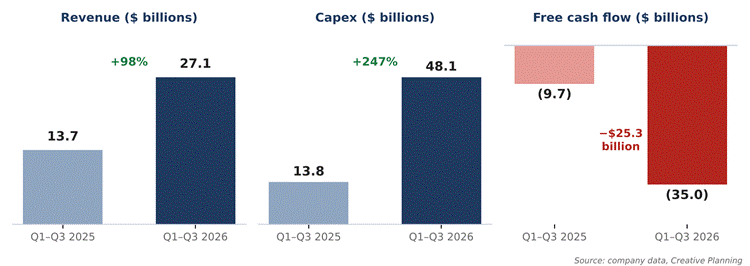
With another $35–40B of capex guided for Q4, investors should watch whether negative free cash flow keeps widening in the coming quarters and how the company funds it.
- Returns may not last. Management says new capacity pays back in under a year, but that depends on pricing and demand as more competing capacity comes to market.
- Enormous capital needs. Q4 capex is $35–40B, and Reuters reported ~$40B of financing for Nvidia chips. Power, cooling, debt costs and GPU depreciation all weigh on returns.
- The $1T ambition is not guidance. Musk’s $500B–$1T ARR figure is an informal projection. The official targets are $33–37B for Q1 2027 and $100B ARR by end-2026.
- Execution risk. Timelines for Starship, Terafab and the capacity build-out are aggressive. Any delay could weigh heavily on the share price.
📌 Summary
SpaceX is rapidly becoming an AI infrastructure company as well as a space and connectivity one: revenue grew more than 2.5 times, and management expects Q1 2027 revenue alone to exceed all of 2025. On the other hand, the growth requires enormous investment, and the valuation already reflects a very optimistic scenario. The key question is whether this growth will earn an adequate return on the capital invested over time.
Thank you very much for taking the time to read this research! Before making any financial decision, gather as much information as you can and weigh the risks carefully.
DISCLAIMER
This market research is provided for informational and educational purposes only and does not constitute investment advice or a solicitation to buy, sell or hold any financial instrument. The information is based on public sources, company statements and analyst estimates, whose accuracy we cannot guarantee. Past performance and forecasts do not guarantee future returns. Before making any financial decision, please consult your finance representative.